I'm a bit peeved, because I can't get my slideshow to embed as I wish. :(
So, anyway, here is the link to some of my pics of La Carolina.
Showing posts with label la carolina. Show all posts
Showing posts with label la carolina. Show all posts
Friday, March 8, 2013

Thursday, August 9, 2012
Life In La Caro
It's a bit of a laugh to be doing this post about La Carolina, in Andalucia, from little old Napier in New Zealand! However, I'm home now, and catching up on the blogs which is was having too much fun to write while I was over there.
So, what are some of the more amusing aspects of living in La Carolina?
So, what are some of the more amusing aspects of living in La Carolina?
- On a 23 degree day, if you wear summery clothing, people will remark '¡Qué frío!' (How cold!) as you go past them.
- When you're looking for something to do on a Sunday, going to a bar is almost your only option!
- It's Carnaval time, and one of the main attractions is the Entierro de la Sardina (Burial of the Sardine...), during which a large paper mâché sardine is taken into various bars around town, as well as Mercadona (the supermarket).
- Teachers bribe their students to behave, or get good results, with chorizo.
- Your fair-haired flatmate is referred to as 'rubia' (blonde).
- You can't leave home without seeing about four people whom you know, or at least meeting someone new who knows the mother of the teacher you work with.
- People can be heard casually dropping phrases like 'a mi me mola que te cagas' (≈ I dig it so much you'd sh*t yourself) into conversation.
- You will be chastised for putting your bag on the ground, and told it will make you lose money.
Monday, May 14, 2012
Summery Friday in La Carolina
Everyone seems to be in a good mood, because they know that this weekend is feria! That means that it's a long weekend, too, because everyone gets Monday off work and school. The kids who have just finished school are meeting up with their friends and planning how to get the best out of feria.


The market is a bustling hive of activity, as people stock up on fruit, veg, meat, embutidos (cured meat), cheese, and meat before the weekend. As for the supermarket... I can tell you that a fair few bottles of booze (especially manzanilla are being carried out of there).
 |
| Rebujito: where the manzanilla is going. |
 |
| Outdoor bar at feria. |
 |
| Another caseta at feria. |
In the streets, everyone's scurrying along close to the buildings, trying to escape from the sun which is beating down. Summer seems to have arrived overnight, and we're suddenly remembering why siestas are so awesome, and why nothing happens in this town between about 2.30pm and 6pm. It doesn't make sense in winter, but I can certainly see why no-one's keen to be out and about at these times in summer.
 |
| Calle Madrid, La Carolina |

There's one man, however, who isn't trying to stay in the shade. He's fairly old, and extremely tanned. While everyone else is fleeing from the midday heat and sun, he's pushing his wheelbarrow through the streets, yelling out the prices for the vegetables that he's selling.

I'm not as brave as him, so I hurry home and bless the lower temperature inside my piso. That's another thing that didn't make any sense in winter, yet suddenly seems genius...
Wednesday, February 22, 2012
¡Una Chirigota, eso sí que es!
Keen as I am to have a taste of all things Spanish, I decided to go with a friend to the Concurso Provincial de Agrupaciones (I can't translate this. My best effort is: Carnaval Singing-Group Competition) and check out what these chirigotas and comparsas were all about.
The ticket was about 10€, but the concert lasted about 6 hours, so I figured it was worth it.
By the time we got there, the concert had already been going for a couple of hours. I saw that one group (all dressed in graduation robes and clown shoes) was singing, and thought that we'd better wait outside so as not to disturb their performance.

I shouldn't have worried; I should have just remembered that we were in Spain. Every performance is interactive, be it clapping along, yelling ¡guapa!, 'campeooooones, campeooooones' or whatever else comes into your head at the time (including the chant which is the title of this post), dancing... you name it. Someone walking in halfway through is probably the least of your worries.
Group after group appeared on the stage and, with each one, my suprise grew. Not only do we have such a large number of talented singers and performers in the little lost province of Jaén, we also have to remember that someone in each of these groups has composed the songs, and written the lyrics. Then there were the costumes... The money and time which must have been spent on this is just incredible. People told me there was a strong tradition of carnaval here, and I didn't quite understand until that moment!


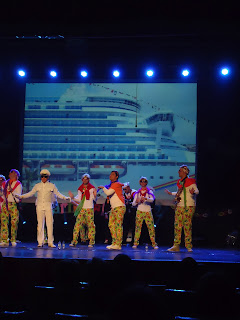

Unfortunately, I couldn't understand the lyrics, as speedy, sung Spanish is a bit too much for me, especially when they're making jokes about current events and people that I don't know anything about- or double entendres that go completely over my head. So, when the whole theatre was roaring with laughter, I just had to smile and hope I caught the next joke.
One kind of joke that I could get, however, was the musical joke. When, for example, the last group in the competition (bakers) modified Michael Telo's Ai Si Eu Te Pego (extremely popular Portuguese song over here at the moment) and made it into instructions for making bread dough (finally, after a few hours, I start catching some lyrics), even I could giggle.
Before I knew it, 4 hours had gone by, and it was time to head out into the cold, cold street again. So, if you ever get the chance to see carnaval groups performing: GO!
The ticket was about 10€, but the concert lasted about 6 hours, so I figured it was worth it.
By the time we got there, the concert had already been going for a couple of hours. I saw that one group (all dressed in graduation robes and clown shoes) was singing, and thought that we'd better wait outside so as not to disturb their performance.

I shouldn't have worried; I should have just remembered that we were in Spain. Every performance is interactive, be it clapping along, yelling ¡guapa!, 'campeooooones, campeooooones' or whatever else comes into your head at the time (including the chant which is the title of this post), dancing... you name it. Someone walking in halfway through is probably the least of your worries.
Group after group appeared on the stage and, with each one, my suprise grew. Not only do we have such a large number of talented singers and performers in the little lost province of Jaén, we also have to remember that someone in each of these groups has composed the songs, and written the lyrics. Then there were the costumes... The money and time which must have been spent on this is just incredible. People told me there was a strong tradition of carnaval here, and I didn't quite understand until that moment!


Unfortunately, I couldn't understand the lyrics, as speedy, sung Spanish is a bit too much for me, especially when they're making jokes about current events and people that I don't know anything about- or double entendres that go completely over my head. So, when the whole theatre was roaring with laughter, I just had to smile and hope I caught the next joke.
One kind of joke that I could get, however, was the musical joke. When, for example, the last group in the competition (bakers) modified Michael Telo's Ai Si Eu Te Pego (extremely popular Portuguese song over here at the moment) and made it into instructions for making bread dough (finally, after a few hours, I start catching some lyrics), even I could giggle.
 |
| The bakers. |
Before I knew it, 4 hours had gone by, and it was time to head out into the cold, cold street again. So, if you ever get the chance to see carnaval groups performing: GO!
Tuesday, February 21, 2012
A Christmas Carol: Ballet in La Carolina
Christmas has long gone, but better late than never, right?
Before Christmas, there was one afternoon in which the kids at school were totally hyper, as there had been some kind of sports event in the morning, and they were truly incapable of working during the last hour of the day. So, the teacher I was with decided we could at least do something useful, and got them to practise their English by asking me questions.
As soon as one girl found out that I liked dancing, she started trying to sell me tickets to her ballet recital. However, there were two in the class dancing in the same show, and both wanted to sell me a ticket... Luckily for me, the teacher solved my dilemma by telling me that she'd already bought about 5 tickets from one of the girls, so I let the other make the great sale of one ticket to me.
My friend, the teacher whose class I was in, told me that I wouldn't regret going to the show, and she was certainly right. I wasn't expecting to see something of such a high level in little old La Carolina. As it turns out, we have quite a few talented dancers here!
There were the little ones, who were extremely cute - you could see how they were watching their leader to copy the moves. Unfortunately, I don't seem to have pictures of them. Here are the smallest ones that I found...

Then they got a bit bigger, and more complicated...

And, finally, the big kids. These guys knew what they were doing!


Best 3€ I've spent in a long while!
Before Christmas, there was one afternoon in which the kids at school were totally hyper, as there had been some kind of sports event in the morning, and they were truly incapable of working during the last hour of the day. So, the teacher I was with decided we could at least do something useful, and got them to practise their English by asking me questions.
As soon as one girl found out that I liked dancing, she started trying to sell me tickets to her ballet recital. However, there were two in the class dancing in the same show, and both wanted to sell me a ticket... Luckily for me, the teacher solved my dilemma by telling me that she'd already bought about 5 tickets from one of the girls, so I let the other make the great sale of one ticket to me.
My friend, the teacher whose class I was in, told me that I wouldn't regret going to the show, and she was certainly right. I wasn't expecting to see something of such a high level in little old La Carolina. As it turns out, we have quite a few talented dancers here!
There were the little ones, who were extremely cute - you could see how they were watching their leader to copy the moves. Unfortunately, I don't seem to have pictures of them. Here are the smallest ones that I found...

Then they got a bit bigger, and more complicated...

And, finally, the big kids. These guys knew what they were doing!


Best 3€ I've spent in a long while!
Sunday, January 29, 2012
Ten Reasons to Visit La Carolina
This is an Andalucian tv programme which visits all kinds of little places and explains to all us tv viewers why we should go there. The particular episode in the link is in my 'pueblo.' All in Spanish, but good to watch a bit to get a feel for what the town is like!
Friday, November 25, 2011
More Pix of the San Juan Procession... Because I Can
And because I took a lot!
It all started off at the Iglesia de la Inmaculada. This is where the floats emerged from, and where everyone formed up to start the procession.
This is San Carlos being brought out of the Iglesia de la Inmaculada.
And here is his buddy, San Juan (who seems to be the star of the show).
Once they have come out of the church, they are then paraded through the streets of the town, like this.
Many people follow the parade, some line the streets and wait for it to come past, and some are lucky enough to see it from their balconies (which are normally bearing a special banner for the occasion).
However, it's not just the floats which are in the parade.
There are also bands, and people representing the different 'cofradias,' a type of religious group which I do not know how to explain, but who are the ones who parade in Semana Santa (Holy Week, around Easter), too. I believe they are often based around a particular saint.
So, all things considered, it is a rather long procession.
Once it has passed through the town, it makes a stop at the Parroquia de San Juan.

There was a lot of this going on:
It then heads back to the Iglesia de la Inmaculada, where the Saints are to be returned to the church.
But, wait... all of the lights have gone out! What's going on?

Ah, yes. The firework display...
This year, it finished with a kind of 'bomb,' the shock waves from which I could feel right through my body. For a minute, I really thought something had gone wrong!


The Saints, who have stayed out to enjoy the fireworks, then head back into the church, and it's on to the next part of the fiesta. :)

It all started off at the Iglesia de la Inmaculada. This is where the floats emerged from, and where everyone formed up to start the procession.
 |
| San Carlos emerges. |
This is San Carlos being brought out of the Iglesia de la Inmaculada.
And here is his buddy, San Juan (who seems to be the star of the show).
Once they have come out of the church, they are then paraded through the streets of the town, like this.
Many people follow the parade, some line the streets and wait for it to come past, and some are lucky enough to see it from their balconies (which are normally bearing a special banner for the occasion).
 |
| San Juan on parade. |
 |
| San Carlos on parade. |
 |
| And it continues! |
 |
| Note the banners and spectators on the balcony! |
However, it's not just the floats which are in the parade.
There are also bands, and people representing the different 'cofradias,' a type of religious group which I do not know how to explain, but who are the ones who parade in Semana Santa (Holy Week, around Easter), too. I believe they are often based around a particular saint.
 |
| A band in the procession for San Juan. |
 |
| Representatives of the cofradías. |
So, all things considered, it is a rather long procession.
 |
| The procession in our street. |

There was a lot of this going on:
It then heads back to the Iglesia de la Inmaculada, where the Saints are to be returned to the church.
 |
| San Carlos on his way back to the Iglesia de la Inmaculada. |
 |
| The procession heading back to the Iglesia de la Inmaculada. |
But, wait... all of the lights have gone out! What's going on?

Ah, yes. The firework display...
This year, it finished with a kind of 'bomb,' the shock waves from which I could feel right through my body. For a minute, I really thought something had gone wrong!


The Saints, who have stayed out to enjoy the fireworks, then head back into the church, and it's on to the next part of the fiesta. :)

¡FIESTA! San Juan de la Cruz
Spain is a very Catholic country, and parties are what Spain is all about. So, of course, the festival of the patron saint is something to be enjoyed! It's a big event, which brings many inhabitants out into the streets, wearing their best clothes, and waiting to cheer for their Saint as he emerges from the church.
There are several important parts of the festival.
 |
| San Juan being paraded through the streets of La Carolina. |
 |
| San Juan at his home church. |
- Procession which takes the figures of San Carlos and San Juan to the Chapel of San Juan, where San Juan is said to have lived.
 |
| The procession, with its floats and bands, makes its way through La Carolina. |
 |
| Building up to the finale, November 2011 |
- Firework displays
 |
| Firework display during 2011 Fiesta de San Juan de la Cruz |
- Shared meal
- Raffle of a live pig
- Sports tournaments
- Drawing competition for kids

San Juan de la Cruz: Patron Saint of La Carolina
Yesterday was November the 24th, and something big started happening in La Carolina: the festival of the town's patron saint (San Juan de la Cruz).
Here's what I have managed to gather in terms of his history, with the help of St John of the Cross, New Advent, and La Orden Carmelita en Málaga, by Eduardo Postigo Pérez, and a few other sites!

Short version: He was an important figure in the the order of Discalced Carmelites. He was born into an extremely poor family and, eventually, realised that it was his calling to serve God. He worked with St Teresa of Jesus, who was reforming the Carmelites in Spain. He founded many convents in Andalucia, and apparently lived in La Carolina at one point. He eventually died in Ubeda, which is about 40 minutes from La Carolina by car.
As an aside, according to Pope Benedict XVI, Saint John of the Cross is also considered to be one of the most important lyrical poets in Spanish literature.

Long version:
He was born Juan de Yepes, on the 24th of June, 1542, in Fontiberos, Castilla Vieja. His family was extremely poor. While he was a bright pupil, he couldn't seem to learn a trade. After helping in the local hospital, caring for the poorest of the poor and attending a Jesuit school, he realised that his calling was to serve God.
He took the robes in Medina, a Carmelite order, in February 1563, as Juan de San Matías. In 1567, after further studies, he became a priest. However, he became overwhelmed with all of his responsibilities, and disillusioned with the leadership, and almost converted to the Carthusian order.
His friend Saint Teresa convinced him to stay with the Carmelite order. She was heading a reformation, as she wanted to return to "the Primitive Rule embodying Carmel's first ideals." Juan worked with her in several different areas of Spain: initially helping to train novices, and eventually as director and confessor.
In 1577, Juan de la Cruz was ordered to return to the house of Medina, and was imprisoned in Toledo when he refused to do so. After almost a year of imprisonment in awful conditions, he miraculously escaped. For the next few years, he founded and directed monasteries in many areas in Andalucia.
After Saint Teresa died, Juan (now vicar of Andalucia) rejected a change in the distribution of power in the order. This apparently disgusted one of his superiors, who sent him away to one of the poorest monasteries.
He then fell seriously ill, and retired to the monastery in Ubeda. Unfortunately, due to his treatment there, he spent the rest of his life fulfilling his prayer: to suffer and be despised.
However, in the end, even his enemies had to recognise his sanctity. He was canonised on the 27th of December, 1726.
San Juan in La Carolina
San Juan de la Cruz is not the only patron saint of La Carolina and, for this reason, he has to share the glory with San Carlos. For instance, in the traditional procession, both San Juan and San Carlos are carried through the streets.
 |
| A statue of San Juan de la Cruz outside the Church of la Inmaculada, La Carolina. |
The hymn of La Carolina includes the following verse:
Por esa tierra de Jaén
renace el vergel
de San Juan de la Cruz.
La Carolina le hizo patrón
y aquí quedó como andaluz.
This is as well as I can translate it:
In this part of Jaen (province)
the orchard of St John of the Cross
was reborn.
La Carolina made him their patron saint
and there he stays: Andalucian.
Saturday, November 19, 2011
When I Came to Spain, and I Saw the People Partying...
I would have done more blog entries, but I was too busy partying... all day, and all night...
(That's a reference to this song, for those who didn't know. ;p It's a pretty awful song but the funny thing is that it's actually kinda true. Spanish people do like to party! Or, at least, socialise.)
So, a few snippets of life in La Carolina.
 |
| El Cerro de la Cruz, with La Carolina behind. |
- A couple of days ago, the teacher said something to a student, and he replied 'joder, maestra.' The teacher (somewhat bravely) said 'In English. How do you say 'joder, maestra,' in English. The student's reply: 'F@*k, teacher.'
I put my head in my hands and told them that they could not say that to a teacher. Another student said 'why not?' - Regular tapas sessions. The teachers at my school are terrible influences in this respect!
- Have started jogging again, because I am eating too many tapas and drinking too much cerveza.
- On the upside, I have discovered 'clara.' It apparently has lemon juice. Anyway, that means it's less bitter, so I'm happy.
- Doing about four different language exchanges to speak some more Spanish. Spaniards are really keen to learn English!
- Spending lots of time with the other auxiliares, amusing ourselves with stupid dance moves, playing Headbands or other such party games, dancing it up around town, having dinner parties, watching movies... Basically, we always find something entertaining to do!
- Spending Sunday nights in a bar, taking free salsa lessons.
- Last night, I was in a bar at about midnight, only to see two of my eleven-year-old students there with their families. (This seems to be reasonably usual in Spain.) They came over to say hello, which was sweet of them. But I'm waiting for Tuesday, when they say 'Teacher, I saw Libby drinking wine in a bar!' Because they do like to tell their other teachers about how they saw me in the street, etc, etc.
- Checking out the Saturday morning market. Apparently, most of the vendors are gypsies. There are cheap shoes, clothes, and sheets galore. Plus, it's right by the town market, where I can get a big bag full of fruit and veg for only 5E. Huzzah!
- Recently gained a few 'students': some who want some extra conversation practice, some school kids, and possibly a 3-year-old to follow. That one could be fun!
 |
| Kingi the Kiwi, getting ready to tuck into patatas bravas! |
Subscribe to:
Posts (Atom)